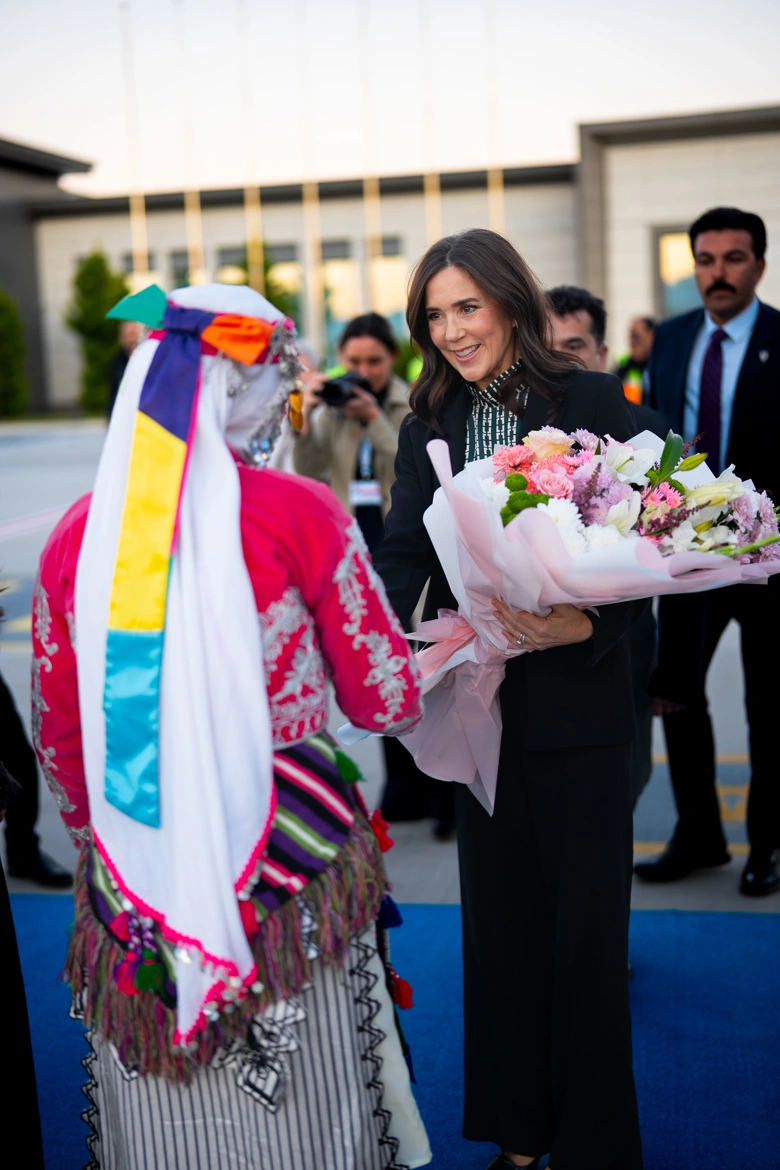
H.M. Dronningens tale ved COP31 i Tyrkiet den 9. november 2026
Minister, Your Excellencies, ladies and gentlemen,
It is a pleasure to welcome you to the opening of the Denmark Pavilion at COP31.
I would like to begin by thanking Türkiye and my birth country, Australia, for their leadership at this year’s COP.
The climate crisis is accelerating. The latest UN Emissions Gap Report makes clear that, despite progress, the world is not cutting emissions fast enough.
For more than a decade, 1.5 degrees Celsius has been a widely recognised benchmark for global climate action. The report warns that this threshold will be exceeded. But the goal remains.
Our commitment now must be to limit how high temperatures rise and for how long they exceed the 1.5-degree benchmark.
Every fraction of a degree matters.
No country in the world is untouched by climate change, but some countries are more affected than others. For many island nations and low-lying coastal communities, extreme weather, rising sea levels and loss of biodiversity threaten lives, livelihoods and the future of their homes.
During visits to Vanuatu and Fiji, and to the coastal district of Satkhira in Bangladesh, I met people living with such consequences. They shared with me their stories of human suffering, environmental destruction and economic losses.
Meeting those who are both directly and disproportionately impacted gives the statistics a human reality and serves as a reminder of what is at stake.
Last month’s pre-COP meetings in Fiji and Tuvalu brought those realities to the heart of the preparations for this conference.
COP remains essential to our collective response. It brings the world together to build trust and commitment, to find agreement and common ground and to hold one another accountable.
Here in Antalya, nations, businesses and civil society gather to turn that shared responsibility into agreements, investments and implementation – simply put, concrete results.
The COP31 Presidency has set out an ambition – among others – for electricity to meet 35 per cent of global final energy demand by 2035.
This ambition offers a real opportunity to replace fossil fuels with clean electricity in transport, industry and heating.
That requires expanding renewable energy, strengthening electricity networks and improving energy efficiency together.
Denmark has made substantial progress in renewable electricity generation. In 2025, more than 75 per cent of the domestic electricity supply in Denmark came from renewable sources. Yet electricity still only accounts for around 20 per cent of our entire energy consumption.
Danish businesses are ambitious to accelerate electrification substantially which is an encouraging example of the private sector’s eye for opportunity and investments – and ultimately their role in contributing to the green transition.
Many of the electrification technologies we need already exist, and Denmark has valuable expertise and experience to contribute. Through collaboration – public authorities, businesses, research institutes and private foundations – have developed solutions that help to advance the transition to greater use of green electricity at home and abroad.
Let me offer you an example connecting Denmark with Türkiye and Australia.
Last year, I had the pleasure of naming Denmark’s first electric tugboat – actually after my husband’s grandmother, Queen Ingrid. Built here in Türkiye for a Danish company, she now works more cleanly in the waters between Denmark and Sweden.
And in March this year, my husband Frederik and I visited the INCAT shipyard in Hobart, Australia, where three battery-electric ferries are currently being built to connect regions of Denmark by providing clean transport.
There was something almost symbolic about seeing three state-of-the-art ferries take shape in the city where I grew up, knowing that they will one day serve the country I now call home.
These vessels show what international cooperation can achieve by putting green technology to work. But they must also meet everyday operational demands. They must perform reliably. Charging must not compromise their operating schedule. And the investment must make financial sense.
Many of you here today are striving to meet similar demands.
You understand that an electric vessel needs more than a battery. Often one solution is like a piece in a jigsaw puzzle – it has to fit with a lot of other pieces in order for it to make sense. For example, charging facilities on shore, a reliable supply of clean electricity and adequate electricity grid capacity.
The same applies beyond our harbours. For electric furnaces in factories, electric vehicles on our roads, heat pumps in buildings and in our homes.
Electrification is one of several important paths towards a greener future. Powered by clean and renewable energy, it can reduce emissions, strengthen energy security and help businesses become more competitive.
When a greener solution also makes good business sense, there is a powerful incentive to invest – and to keep on investing.
The private sector is already playing a vital role in advancing the green transition through investment and innovation. Its continued commitment is crucial. The transition gathers pace when more businesses see a sound investment and have the confidence to make it.
Businesses bring expertise, investment and willingness to try something new. Governments provide clear, stable frameworks and political commitment. Energy companies and infrastructure providers help ensure that clean power is available where and when it is needed – at a competitive price.
Creating those conditions is a shared responsibility.
And it is vital to always remember that behind every discussion of technology, investment and competitiveness, the single most important reason that brings us here – is protecting people, nature and the future we share.
The urgency of climate change is clear. But so is our growing ability to respond. Technology is advancing faster than expected.
Last year, renewable sources accounted for more than 85 per cent of new electricity generation capacity worldwide. We must build on that progress – turning commitments into implementation.
The Denmark Pavilion showcases a range of Danish expertise and solutions that contribute to both electrification and the green transition at large. It is a place to share ideas, learn from one another and build partnerships.
My hope is that the conversations here will inspire action, unlock investments and turn ambition into lasting benefits and a sustainable future for people and our planet.
Thank you.
(Det talte ord gælder)